


For God And Kaiser - The Imperial Austrian Army 1619-1918
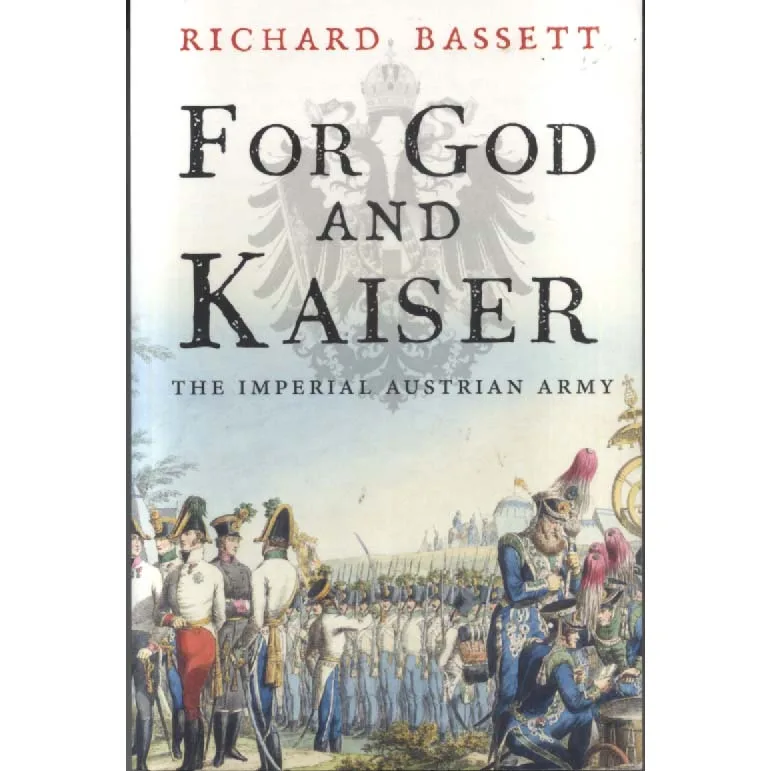
Publisher: Yale University Press
Format: Paperback
ISBN: 9780300219678
For God and Kaiser is one of those titles that arrives already wearing parade uniform. Richard Bassett’s grand history of the Imperial Austrian Army covers nearly three centuries of military life in that most gloriously overcomplicated of European arrangements: the Habsburg world, where loyalty, language, dynasty, bureaucracy and battlefield courage were all expected to coexist in one vast imperial machine, preferably without too much mutiny.
This is not merely a book about armies in the simple sense of men marching about in boots and making maps nervous. It is a book about the Imperial Austrian Army, which means it is also about empire, identity, survival, administration, faith, aristocracy, nationalism, and the peculiar challenge of commanding troops drawn from a political entity that often seemed held together by ceremony, tradition and a sort of exhausted magnificence. The Habsburg monarchy was never going to do anything in a small or tidy way, and its army, naturally, reflected this with gusto.
Bassett’s subject is irresistible because the Austrian army spent centuries doing the deeply unfashionable but essential work of keeping a sprawling multinational empire from being eaten alive by its neighbours, dismantled from within, or simply collapsing under the weight of its own paperwork. Here are the Turks, the Prussians, the French, the Italians, the Hungarians, assorted revolutionaries, and finally the twentieth century arriving like a badly aimed artillery shell. Through it all marches the imperial army: stubborn, ceremonial, adaptable, archaic, heroic, often underestimated, and somehow still functioning.
And what a setting. The Habsburgs always understood that if one is going to preside over a vast and improbable political organism, one may as well do it in style. So this is military history with extra plumage: white coats, dynastic solemnity, Catholic grandeur, imperial nostalgia, and officers who seem to have stepped straight out of central European opera and into campaigns of terrifying seriousness. But the splendour is only part of the attraction. Bassett is clearly interested in the real institutional achievement behind the pageantry: how this army worked, why it endured, what it meant to the state, and how it navigated the long, humiliating, glorious and often contradictory history of one of Europe’s strangest great powers.
There is a particularly delicious irony in the Austrian army’s reputation. In popular imagination it is too often reduced to a sort of decorative military appendix to a doomed empire, all braid and melancholy and eventual collapse. But books like this exist to remind us that empires do not survive for centuries on uniforms alone. The Austrian army fought major wars, checked Ottoman expansion, helped shape the balance of Europe, and served as one of the principal pillars of Habsburg continuity. It may have ended in 1918 amid the ruins of the old order, but before that it had been one of the great armed institutions of Europe, carrying an enormous historical burden with rather more competence than the jokes usually allow.
The date range alone is enough to make one sit up straighter: 1619 to 1918. That is not a history; that is a civilisation in arms. Through confessional wars, dynastic struggles, Napoleonic upheaval, nineteenth-century nationalism and modern industrial slaughter, the army remains the thread. Regimes change, tactics evolve, enemies shift, and yet the imperial military ethos persists: God, Kaiser, duty, survival, and perhaps the occasional desperate hope that the supply lines are better than last year. It is history on a truly satisfying scale.
This 2016 Yale University Press edition sounds exactly right for such a subject: serious, handsome, authoritative, and likely to look extremely distinguished on a shelf. Yale books have a habit of radiating calm intellectual confidence, and this one almost certainly does so in full dress uniform. It is the kind of volume that suggests its owner may have opinions not just about Europe, but about Mitteleuropa, dynastic legitimacy, and whether the Habsburg collapse was really inevitable. Excellent shelf energy, in other words.
And this particular copy, sold by Crappy Old Books in As New condition, offers the especially pleasing contrast of a book about centuries of warfare, attrition, siege, imperial strain and eventual dissolution arriving in improbably crisp condition. The empire may be gone, the regiments disbanded, the monarchy folded into history, but your copy can still appear as fresh as a newly issued commission. That seems only fair.
So For God and Kaiser is a feast for readers who like military history with politics attached, imperial history with uniforms attached, and European history with a proper sense of scale attached. It is about war, certainly, but also about endurance, institution-building, identity and the odd miracle of holding together a multinational monarchy by means of discipline, tradition and armed force. Which, when you think about it, is quite a lot for one army to be getting on with.
In short: a rich, elegant, martial history of the Habsburg army and the empire it served, full of splendour, strain and central European seriousness. Crappy Old Books is delighted, naturally, to offer this crisp copy of a book about one of history’s great imperial machines—an army that spent three centuries defending throne, altar and a political arrangement so elaborate it practically required its own orchestra.
Keep browsing: See more War books Other books by Richard Bassett
